Food for Tomorrow Institute and ICLEI South America Payment for Environmental Services, commonly referred to as PES, is defined by law (Law No. 14,119/2021) as an economic instrument providing monetary and non-monetary incentives to individuals [...]
WRITTEN BY COMIDA DO AMANHÃ
on 03/10/2025
|
Food for Tomorrow Institute and ICLEI South America
Payment for Environmental Services, commonly referred to as PES, is defined by law (Law No. 14,119/2021) as an economic instrument providing monetary and non-monetary incentives to individuals or communities that conserve or restore ecosystems, following the logic of the “protector-recipient” and “user-payer” principles . These principles value fundamental ecosystem services such as climate regulation, pollination, soil and water protection, biodiversity conservation, among others (TEEB, 2017). Recognized as fundamental to maintaining planetary health (Whitmee et al, 2015), and important both for the conservation of ecosystems and for the recognition of family farmers and traditional peoples and communities that inhabit them (FAO, 2019). In recent years, the adoption of Payment for Environmental Services (PES) programs has been strengthened at the state and municipal levels, although pioneering experiences have been underway since the mid-2000s, such as the Water Conservation Program in Extrema (MG), considered the first municipal PES in the country (Pagiola, Von Glehn, and Taffarello, 2013). This history shows that, even before national institutionalization through Law No. 14,119/2021, local governments were already playing a leading role in the formulation of policies aimed at environmental conservation, creating innovative arrangements that today serve as a reference for the integration of ecosystem services and sustainable food systems.
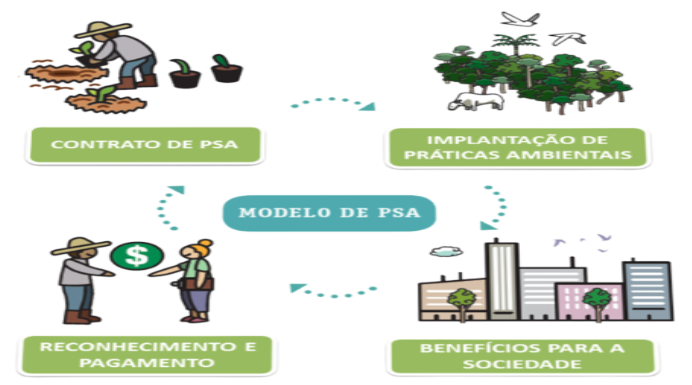
Figure 1: PSA Operating Model
Source: Bahia State Secretariat for the Environment (SEMA), State Program for Payments for Environmental Services – PEPS
In summary, as the image above shows, the PES model is based on the formalization of contracts, the implementation of sustainable environmental practices by ecosystem service providers, and the recognition and remuneration of these providers, generating direct and indirect benefits for society as a whole. Also according to Law No. 14,119, ecosystem services can be classified into four main categories: provisioning services, which provide environmental goods or products used by humans, such as water, food, wood, and fibers; support services, responsible for maintaining life on Earth through processes such as nutrient cycling, pollination, seed dispersal, waste decomposition, and soil fertility renewal; regulating services, which ensure the stability of ecosystems, including carbon sequestration, air purification, regulation of the hydrological cycle, erosion control, and moderation of extreme weather events; and, finally, cultural services, which relate to non-material benefits such as cultural identity, recreation, tourism, spiritual experiences, aesthetics, and intellectual development.
The interdependence between food systems and ecosystem services is evident, since food production depends on processes such as pollination, nutrient cycling, and water regulation, but can also contribute to their maintenance. When conducted through sustainable and agroecological practices, agriculture becomes a provider of environmental services, reinforcing the conservation of biodiversity and ecological cycles. Family farmers and traditional peoples and communities play a central role in providing environmental services through agroecological practices that generate results beyond food production. The conservation of native seeds, the care of water and springs, the maintenance of soil fertility, and the preservation of local biodiversity are examples of practices that contribute to climate regulation and ecosystem resilience. These practices also include traditional agricultural technologies, such as culturally appropriate and locally adapted farming methods that combine food production with environmental conservation. By aligning production with the geoclimatic conditions and biological diversity of each territory, these groups ensure both food and nutritional security and the maintenance of vital ecosystem functions.
The conservation of native seeds and the preservation of areas of native vegetation are essential practices for sustainable production. Such practices contribute to climate change mitigation and territorial adaptation, ensuring productive resilience and food and nutritional security (FAO, 2019). A concrete example comes from quilombola territories: according to MapBiomas data, between 1985 and 2022, the loss of native vegetation in these territories was only 4.7%, compared to 17% in private areas during the same period. In addition, in the Atlantic Forest, one of the most pressured biomes, quilombola territories recorded a net gain of 7,800 hectares of native vegetation, standing out as areas of active conservation. These figures reinforce the fact that traditional community practices result in effective forest conservation and the maintenance of ecosystem services that are fundamental to food systems.
Such actions contribute to climate change mitigation and territorial adaptation, ensuring productive resilience and food and nutritional security (FAO, 2019). By recognizing and economically incentivizing these actors, PES becomes a mechanism for strengthening local economies and promoting socio-environmental justice. Such actions contribute to climate change mitigation and territorial adaptation, ensuring productive resilience and food and nutritional security (FAO, 2019). Studies by Embrapa (2024) show that agroforestry systems can store up to 30% more carbon in the soil than areas of natural vegetation, reinforcing their strategic role in climate mitigation and the enhancement of ecosystem services. By recognizing and economically incentivizing these actors, the PSA becomes a mechanism for strengthening local economies and promoting socio-environmental justice.
Local Governments and Brazilian Experiences
At the municipal level, the City of Ananindeua (PA) established, through Law No. 3,420/2024, its Municipal Payment for Environmental Services Program (PSA), within the scope of the newly created Municipal System for Combating Climate Change. The initiative is coordinated by the Extraordinary Municipal Secretariat for Combating Climate Change, in partnership with the Secretariat of Fisheries and Agriculture, and is part of a broader set of policies aimed at forest conservation, REDD+ (Reducing Emissions from Deforestation and Forest Degradation), the creation of conservation units, and the promotion of the green economy. In 2025, the first call for proposals prioritized quilombola communities, selecting 35 families to receive monthly payments of R$400.00 for 12 months, totaling R$168,000. The funds support actions to recover degraded areas, sustainable forest management, and protection of springs and watercourses. Beyond the environmental dimension, the program values community practices that combine traditional knowledge with climate adaptation strategies, strengthening social inclusion, food and nutritional security, and local resilience to climate change. The policy seeks to recognize community practices that are already part of the local way of life, such as collective reforestation of degraded areas, sustainable management of forest resources, restoration of springs and streams, as well as initiatives by waste pickers that contribute to reducing pressure on ecosystems. By valuing these actions, the PSA connects traditional and community knowledge with modern climate policy instruments, strengthening both social inclusion and environmental resilience in the territory.
At the state level, Bahia stands out with its State Program for Payment for Environmental Services (PEPSA), established by Law No. 13,223/2015 and coordinated by the State Secretariat for the Environment (SEMA). This is a public PES system that combines monetary and non-monetary incentives, such as direct payments, certifications, technical assistance, and environmental education activities, aimed especially at family farmers and traditional peoples and communities. The program seeks to value the ecosystem services provided by these groups, encouraging biodiversity conservation, the recovery of degraded areas, and the sustainable use of natural resources. Among its actions, initiatives such as the Guardians of the Waters of the Joanes and Jacuípe Rivers project, cooperation agreements with conservation organizations, and territorial meetings of rural women stand out, reinforcing the social and community character of PEPSA, integrating environmental conservation with social inclusion and sustainable territorial development.
At the national level, the Floresta+ Amazônia Project, implemented by the Ministry of the Environment in partnership with the United Nations Development Program (UNDP), illustrates how PES can reach family farmers and agrarian reform settlers, linking forest conservation with diversified agricultural production. With a contribution of US$96 million from the Green Climate Fund, the initiative has already rewarded the conservation of almost 5,000 hectares of forest, benefiting more than 700 families, most of whom are women farmers. Its modalities range from direct payments to farmers who conserve or restore areas of native vegetation to support for community projects developed in a participatory manner by local organizations, valuing collective management of territories. It also promotes innovative solutions linked to the environmental services market and offers support to public institutions and cooperatives working to prevent deforestation. In addition to reducing socioeconomic vulnerabilities, the program reinforces the role of Amazonian food systems as allies in the fight against climate change (UNDP, 2025).
Strengthening local PES policies represents a strategic opportunity to align conservation, climate adaptation, and the promotion of food and nutritional security. By valuing family farmers and traditional communities as providers of environmental services, municipalities can increase resilience, foster sustainable food chains, and contribute to the achievement of the Sustainable Development Goals. The experiences of the municipality of Ananindeua, in the state of Bahia, and at the federal level with the Floresta+ Amazônia program show that PES, when linked to local policies, transcends its compensatory nature and becomes a structuring axis for fair, inclusive, and climate-resilient food systems.