Instituto Comida do Amanhã e ICLEI South America Presenting the problem In recent years, cities have been severely affected by events resulting from the climate crisis. However, they have enormous potential to play a leading [...]
WRITTEN BY COMIDA DO AMANHÃ
on 19/01/2026
|
Instituto Comida do Amanhã e ICLEI South America
Presenting the problem
In recent years, cities have been severely affected by events resulting from the climate crisis. However, they have enormous potential to play a leading role in responses—both mitigation and adaptation—to this crisis. Amid floods that isolate neighborhoods, droughts that disrupt harvests, and heat waves that threaten public health, local governments have sought their own ways of resilience and care. The potential of food as a guiding principle for climate adaptation strategies is evident, but remains largely unexplored by public policies.
The fact is that the way we produce, distribute, and consume food is deeply intertwined with the climate emergency. Food systems account for more than a third of global greenhouse gas emissions, according to the FAO (2021), while in Brazil, agriculture and land use account for even more, being the largest sources of emissions, according to data from SEEG. At the same time, extreme events directly affect the price and availability of fresh food in urban peripheries, with direct consequences for the food and nutritional security of urban populations, especially the most vulnerable. Food therefore occupies a central position in the problem, but it must also be a central part of the solution.
By investing in strategies that integrate food systems into the climate agenda, as pointed out in the Guide for Public Managers: Circular Food Systems in Latin America, prepared by FAO and ICLEI, opens the way for practices that promote the circularity of these systems, prioritizing regenerative production, favoring reuse and sharing, reducing resource input and pollution, and ensuring the recovery of inputs for future use. This closes resource cycles and creates intersectoral synergies, for example, with water and energy systems, which strengthen the resilience of territories.
Furthermore, considering the climate impacts related to food systems, the adoption of circular strategies can also contribute to reducing carbon emissions from food waste, while promoting carbon sequestration and the generation of new sources of sustainable energy, such as waste heat or anaerobic digestion of organic waste. As highlighted in the FAO Climate Change Strategy (2022-2031), the circular and sustainable bioeconomy has been identified as a priority area for transforming agri-food systems and making them more sustainable and resilient to climate change.
The Covid-19 pandemic and the worsening of climate disasters have demonstrated how vulnerable food systems are to simultaneous and interconnected shocks. The global study Lessons learned from city region food systems under multiple shocks and stresses, conducted by FAO, CIRAD, and RUAF (2024), analyzed 11 cities in different regions of the world and revealed that the most severe shocks were felt most acutely in the stages of production and consumption: farmers lost crops and income, consumers faced food inflation, and logistics chains collapsed.
In addition, the above-mentioned study is reinforced by the argument in the article published in Nature entitled Climate change in your backyard: the role of local governments, which also points out that centralized national responses have often failed to adapt to local realities, and that local initiatives, such as community kitchens, urban gardens, food banks, and short marketing circuits, have proven to be much more effective and agile in the face of emergencies, emphasizing the urgent need for local governments to strengthen the resilience of food systems to address health, climate, and economic challenges. Here in Brazil, the study Greenhouse gases in short, medium, and long food chains: a comparative analysis of food miles for a food basket for Brazil based on data from PROHORT/Ceasas conducted by the Study and Research Group on Agriculture, Food, and Development (GEPAD) showed that short chains, those that bring production and consumption closer together, emit significantly less CO₂. This opens an important window for strengthening public food policies and developing local strategies more aligned with addressing the climate crisis.
From this perspective, cities that strategically integrate food and climate policies are building systemic resilience, that is, the ability to prevent, absorb, adapt, and transform their food systems in the face of successive crises. This approach is in line with the concept of City Region Food Systems (CRFS), proposed by the FAO, which values the connection between urban centers and their surrounding rural areas, linking food production, distribution, and consumption with other strategic sectors in the territory in order to promote social, economic, and environmental sustainability.
According to the study Lessons learned from city region food systems under multiple shocks and stresses, food policies should be structured based on five fundamental capacities to promote the resilience of food systems. The first of these is prevention, which involves measures such as crop diversification, strengthening the local production base, and creating buffer stocks to ensure supply at critical times. Next is anticipation, with actions focused on climate monitoring, the development of food emergency protocols, and advance planning for responses to foreseeable risks. The third capacity is absorption, represented by structures such as kitchens that offer free meals and food banks that cushion the immediate impacts of crises on the population. Adaptation, in turn, requires the continuous reconfiguration of public policies, such as government purchases adapted to seasonality, the local context, and the diversity of family farming, in order to respond to gradual changes in socio-environmental conditions. Finally, transformation involves more profound and structural changes, such as the transition to agroecological models, the reform of supply infrastructures, and the implementation of new forms of inclusive food governance that recognize local knowledge and promote climate and territorial justice.
The specific cases of the cities mentioned
As highlighted by IPES-Food (2023), cities and regional governments are at the forefront of food-related climate action. According to the report, municipalities can reduce emissions by up to 35% more than countries by applying measures such as waste reduction, encouraging local production, and promoting healthy diets. Although it may seem difficult to implement these local strategies in practice, we present some examples of Brazilian municipalities that already have climate adaptation actions and policies in place through food systems.
First, we present Porto Alegre (RS) as a reference in community response to extreme weather events. During the floods of 2024, which left the city isolated for several days, community kitchens operating in the municipality became strategic points of nutritional, logistical, and emotional support for the affected population. A single unit prepared more than 117,000 meals in a few weeks, with ingredients sourced from family farms and community donations. Recognizing their importance, the City Hall and the State Government began to integrate them into public policy through the creation of Popular Points of Food and Nutritional Sovereignty and Security (PPSSAN), strengthening their infrastructure and links with the local supply network. During extreme events, the city adapts food distribution routes and reactivates decentralized stocks, ensuring quality food even in crisis scenarios. These actions are based on guidelines from documents such as the Emergency Readiness Plan: A Guide for the School Foodservice Operation, from the National Food Service Management Institute, which suggests that school food services be planned in advance for emergencies through clear operating protocols and well-established partnerships with support agencies and local organizations. The experience of Porto Alegre shows how solidarity kitchens can be permanent strategies for climate adaptation and urban food justice.
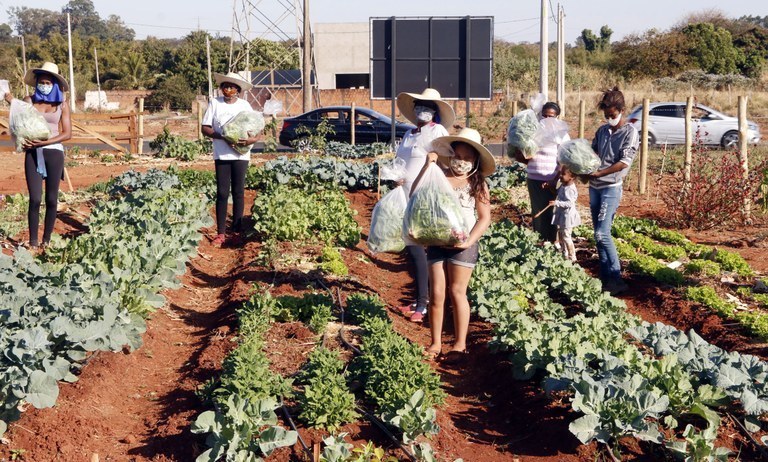
Belo Horizonte (MG) has a well-established Food and Nutritional Security policy, with an agroecological perspective that seeks to integrate urban gardens with rainwater harvesting, agroecological fairs, and a system of public facilities that includes popular restaurants and food banks. The municipality has included the issue of climate change in its Food and Nutritional Security Policy, seeking to ensure sustainable food production systems and implement agricultural practices capable of withstanding climate change.
In another region of the country, we see another case: the municipality of Recife (PE) is investing in urban agroecology and school meals based on fresh, minimally processed, locally sourced products. Although it does not have a defined rural area in its master plan, the city has created an Executive Secretariat for Urban Agriculture, which coordinates policies aimed at food production in urban areas, including rainwater harvesting and organic waste reuse practices. These actions have the potential to reduce emissions associated with transportation and the consumption of ultra-processed foods, thereby contributing to addressing challenges related to water management and socio-environmental vulnerability in urban peripheries.
In Santarém (PA), according to a study published by the Sustainable Finance Initiative with support from Comida do Amanhã for the Brazilian case, all municipal schools are served by the school feeding program, and all fresh and minimally processed items served in meals come from local family farms. Purchases are centralized by the Municipal Department of Education (SEMED), which develops menus in consultation with nutritionists and organizes supply logistics in three distinct regions: urban, plateau (accessible by road), and riverside (where schools can only be reached by river). While non-perishable foods are purchased through conventional public bidding, fresh products are delivered directly by farmers to schools, strengthening the link between producers and cooks. This model not only boosts the local economy and promotes agroecological practices, but also contributes to climate adaptation: by shortening supply chains, diversifying production, encouraging local production, and adapting logistics to the territorial characteristics of the Amazon, it reduces vulnerabilities and ensures healthy and sustainable school meals.
These experiences show that it is possible to react. But is reacting alone enough?
How planning needs to be less reactive
Taking into account the examples mentioned above, it is worth emphasizing that most of the actions taken during recent shocks were absorptive and reactive, not necessarily transformative. In other words, many policies, such as food baskets, subsidies, and emergency programs, served to mitigate immediate impacts, but did not alter structures of vulnerability or prevent populations from continuing to suffer the same impacts on food security from events that are becoming recurrent with climate change. As the report notes: “food systems often revert to their pre-shock functioning, missing the opportunity to promote profound transformations” (FAO, 2024, p.10).
In addition, climate change already directly affects four dimensions of food and nutrition security—availability, access, utilization, and stability—with the most severe impacts on the poorest and most vulnerable populations, women, and traditional peoples, according to the IPCC report Climate Change 2022: Impacts, Adaptation, and Vulnerability. The hegemonic food system, based on monocultures and ultra-processed foods, not only contributes to the climate crisis but also harms human health, with the expansion of the double burden of malnutrition, which combines undernutrition with overweight and chronic diseases, called the global syndemic.
It is clear, therefore, that there are still recurring barriers that limit the transformation of food systems, such as the lack of coordination between national and local policies, the low inclusion of community actors in planning processes, the scarcity of funding for food infrastructure, and the absence of clear indicators to measure transformation and resilience, as highlighted in the report From Plate to Planet: How local governments are driving action on climate change through food by IPES-Food (2023). Despite these challenges, collective initiatives led by communities, civil society organizations, and local governments have demonstrated a greater capacity to promote lasting change, especially when articulated with participatory governance strategies and intermunicipal networks.
To move forward with adaptation actions that create lasting solutions, it is necessary to build food policies with a systemic, integrative, and long-term perspective, according to a recent FAO publication (2025) entitled Transforming food and agriculture through a systems approach. Among the possible paths forward, the following stand out: the revision of social food protection programs, focusing not only on emergencies but also on the structural reduction of vulnerability; strengthening local production and agroecological diversification, with investments in water security for food production, rural extension, and the creation of resilient food infrastructure, such as decentralized markets, public kitchens, composting systems, and local storage; and strengthening participatory governance, with permanent public policy councils, food security councils, and monitoring and transparency mechanisms.
It is precisely in this context that the Urban Laboratory for Public Food Policies (LUPPA) operates, developed by the Food of Tomorrow Institute in partnership with ICLEI South America. The initiative supports Brazilian municipalities in the collective construction of systemic, integrated, and territory-based food policies, with a focus on social justice, climate action, and public health. Through immersions, seminars, exchanges, and learning, LUPPA helps cities transform their food practices into structural solutions, strengthening local experiences and articulating networks between different sectors and levels of government.
Municipal food policies can not only guarantee food on the plate, they also take care of water, soil, biodiversity, food memory, territory, and care relationships. Strengthening local food systems is one of the most effective ways to build climate resilience with social justice. But this requires a change in perspective: understanding food as a strategic and cross-cutting agenda, capable of linking health, the environment, the economy, and culture in lasting public solutions.