The Institute’s director, Juliana Tângari, shared Brazil’s experience with agroecological school feeding at a meeting at UN headquarters and attended other events during Climate Week.
WRITTEN BY COMIDA DO AMANHÃ
on 01/10/2026
|
For the first time, the Comida do Amanhã Institute is participating in New York Climate Week (Climate Week NYC), one of the leading international gatherings dedicated to the debate on climate change and ways to accelerate climate action. Held from September 20 to 27, the program brings together leaders from governments, businesses, civil society, academia, and the philanthropic sector at various venues throughout the city.
Food for Tomorrow’s presence at the event is part of a core principle for the Institute: it is impossible to discuss the future of the climate without also discussing food systems. The way we produce, distribute, access, and consume food is directly related to territories, local economies, land use, and the resilience of communities in the face of climate change. At the same time, extreme weather events affect food production, supply, and access.
Throughout the week, the Institute’s director and co-founder, Juliana Tângari, actively participated in two of the sessions, on September 21 and 22, speaking about Brazil’s experience with food systems and actions taken by municipal governments. Comida do Amanhã was also present at several other events on the program.
School Meals and Connected Territories
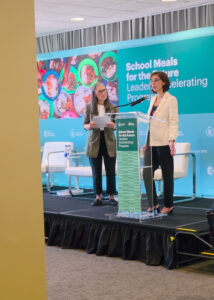
On September 21, Juliana participated in “School Meals for the Future: Leaders Accelerating Progress,” organized by the Rockefeller Foundation in partnership with the World Food Programme (WFP) and the organization Beast Philanthropy, held at the United Nations headquarters in New York.
The luncheon brought together about 100 leaders from national governments, multilateral organizations, the philanthropic sector, and the private sector to mobilize public investments and global partnerships to expand resilient and regenerative school meal programs. The initiative is part of the Rockefeller Foundation’s commitment to help governments provide nutritious meals to an additional 100 million children by 2030 through the School Meals Accelerator.
In this context, Tângari shared the experience of the Agroecological PNAE, a program led by Comida do Amanhã in collaboration with AOPA, Centro Ecológico, CETAP, Instituto Regenera, Centro Sabiá, and Instituto Fome Zero (IFZ), and with the support of the World Food Programme’s (WFP) Center of Excellence Against Hunger in Brazil and the Rockefeller Foundation, to promote the agroecological transition of family farming through public school meal programs and the importance of fostering agroecology in the Brazilian agri-food system, as well as the relevance of effective public policy implementation at the local level for the success of national objectives.
On September 22, the focus shifted to the relationship between cities and rural areas. At the “Feed the City, Sustain the Territory” event, organized by C40, new research was presented on governance structures of public entities for Urban-Rural Alliances (URAs) and the role of cities in building more just and sustainable food systems.
The panel brought together representatives from municipal governments, academia, and the philanthropic sector to discuss governance models capable of bridging the gap between cities, rural areas, and the various actors that make up food systems. Topics included empowering farmers and local enterprises, creating green jobs, building territorial resilience, and reducing emissions.
“At Comida do Amanhã, we believe that the path for agri-food systems toward convergence with the climate agenda involves discussing the role of local governments and understanding territories and territorial arrangements, and that innovation also takes place within the realm of public policy. Of the entire range of possible solutions and paths for the food agenda originating in cities, the most strategic are the policies and actions that incorporate a systemic vision and seek multiple co-benefits. For this reason, at New York Climate Week, Comida do Amanhã conveyed the message of two very important priorities on its action agenda: the agroecological transition driven by school feeding programs in their most comprehensive and ambitious form, and the coordination of governance in metropolitan food systems to ensure the most effective delivery of local results.
The Food Agenda in Different Settings at Climate Week
The week’s program also took Comida do Amanhã to other discussion forums. On September 23, the Institute participated in Food Day 2026, an event organized by the TILT Collective that brought together representatives from various sectors to discuss the transformation of food systems, covering topics such as access to healthy and sustainable food, reducing food loss and waste, sustainable production, public policy, and food environments—including a presentation by ACT Promoção da Saúde on advocacy efforts in Brazil.
On September 24, the Institute participated in the event “The Power of the Public Plate: Health, Climate, and the Culinary Workforce,” organized by the New York City Department of Food and Health Policy. The program discussed the role of institutional meals and procurement in promoting health and sustainability, including the strengthening of regional supply chains and the expanded use of plant-based proteins.